You forgot the meeting deck. Start with the objective and agenda
The room is booked, the participants are joining and somebody finally asks where the deck is. Nobody made it.
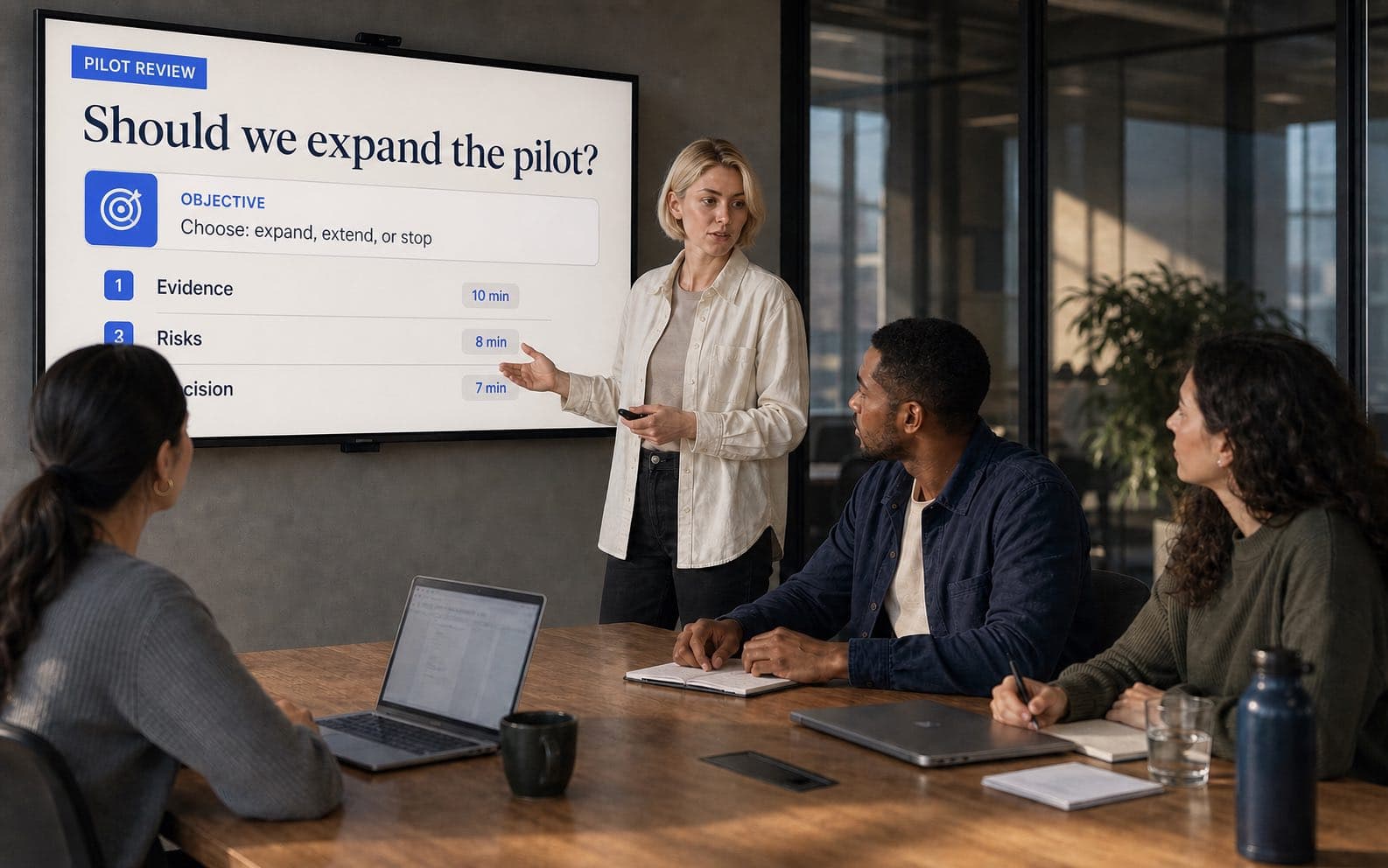
The meeting starts in ten minutes.
The product lead assumed strategy would make the deck. Strategy assumed the product lead had it. The calendar invitation says “pilot review,” but it does not say what the group must decide.
There is no time to build twenty slides—and rushing them now would create decoration, not clarity.
The useful recovery is smaller: write the meeting objective, name the decision the room must make, list the evidence people need and time-box the discussion. That is enough to turn an unprepared gathering into a working meeting.
When the deck is missing, recover the meeting with the smallest useful brief: why the room exists, what must be decided and what the group will discuss.
First, say what the meeting must produce
“Review the pilot” describes a topic. It does not describe an outcome.
A useful objective changes the sentence:
- weak: review the enterprise pilot;
- stronger: decide whether the pilot is ready to expand;
- strongest: choose whether to expand now, extend the pilot for two weeks or stop.
Use a simple test: when the meeting ends, what should exist that did not exist before it began? The answer may be a decision, a ranked list, an approved plan or a named owner. Put that outcome at the top of the record.
Build the smallest useful agenda
Do not recreate the absent deck slide by slide. Organize the conversation around the work the room must do.
For a decision meeting, three agenda items are often enough:
- Restate the decision and constraints.
- Review the evidence and risks.
- Choose the next step and owner.
Give each item a time box. If the meeting has twenty-five minutes, do not spend twenty-three presenting background and two deciding. Protect the final minutes for the outcome the calendar invitation promised.
A short agenda protects the clock better than improvised slides. Give each discussion a purpose and a limit, then reserve the final minutes for the decision.
Bring evidence, not presentation theatre
A deck earns its place when the room needs to inspect something visual: research, financial comparisons, product designs or a sequence that requires explanation.
When the meeting only needs a decision, move the essential evidence into the brief:
- the customer constraint;
- the current options;
- the known risk;
- the question still open;
- links to the source files.
Do not hide the missing analysis behind polished slides. If the evidence is not ready, say so and change the meeting's purpose: identify what is missing, assign it and reschedule the decision.
Keep the agenda with the meeting
Scripta can store the meeting objective, description and ordered agenda items in the meeting record. Agenda items can carry durations, and the schedule can calculate how the time fits together.
That makes the agenda more useful than a last-minute attachment. It remains beside the notes, decisions, action items and files that follow.
Scripta does not currently generate a presentation deck, and its AI-agenda screen is not yet connected to a generation model. The honest value today is the structure: one place to capture what the meeting is for and keep its outcome attached afterward.
Use the no-deck habit before every meeting
You do not need to wait until somebody forgets the slides.
Five minutes before a focused meeting, confirm four lines:
- Objective: what must this meeting produce?
- Decision: what choice or commitment is required?
- Evidence: what does the room need to inspect?
- Agenda: how will the available time be divided?
If those lines are clear, the meeting can begin without a deck. If they are not clear, twenty slides will not rescue it.
The meeting can still start on time
Forgetting the deck does not have to cancel the meeting. It can expose what the meeting needed all along.
Write the objective. Name the decision. Order the discussion. Set the time boxes. Link the evidence.
Then start.
FAQ
Can Scripta generate a presentation deck or agenda with AI today?
When does a meeting actually need slides?
Keep reading
More from the Scripta blog
 Meetings
Ownership is only the beginning of an action item
Assigning a task fixes ambiguity in the room, but it does not guarantee follow-through. An action item also needs a finish line, visible status and the context that made it matter.
 Product
Stop sending meeting recaps as attachments
A recap attachment starts becoming outdated the moment follow-up begins. Share one controlled meeting workspace so minutes, tasks, files and comments stay current together.
 Decisions
A decision log is only worth what you can find in it
Teams write decision records carefully and then never test the read. Retrieval, not recording, is where a log earns its keep — and people look things up by the constraint, not the title.
 Product
Introducing Scripta: the workspace that starts when the meeting ends
Scripta turns meeting notes and transcripts into shared minutes, decisions, action items, files and discussion—so the work after a meeting stays connected.