Nobody wants to be the meeting note-taker
The person writing every sentence is present in the meeting, but they are not fully participating in it.

“Who is taking notes?”
The room becomes quiet because everybody understands the hidden assignment. The note-taker must listen, interpret, type, identify decisions and notice commitments—while still contributing to the conversation.
That is not one job. It is several jobs competing for the same attention.
A better habit is to capture a rough skeleton during the meeting, then turn it into reviewed minutes afterward. The skeleton can be incomplete and ugly. Its purpose is to preserve the anchors AI and the team need: topics, decisions, names, dates and unresolved questions.
Capture anchors, not sentences
Do not attempt a transcript by hand.
Write short anchors such as:
- pricing page ships this sprint;
- Mira checks model latency by Thursday;
- annual discount wording still open;
- client needs revised plan;
- next review on 18 August.
Use names when somebody accepts work. Mark uncertainty when the room does not decide. Add a phrase about why a task matters when the context will be hard to reconstruct later.
The note-taker can now return to the discussion instead of translating every speaker into polished prose in real time.
Turn the skeleton into a readable draft
Scripta can use written notes to propose a structured meeting write-up. The generated draft organizes the material into context, topics, decisions and next steps.
The input is whatever the meeting left behind — a transcript or shorthand typed at speed. The output is the same facts, structured. The question nobody answered is still a question: structuring never upgrades what was said.
The speed matters because the alternative is usually delay. Once the meeting ends, the person who took notes has other work waiting. A rough document remains rough, and the team begins acting from memory.
AI removes the rewriting burden. It does not remove responsibility for the record.
Review before the draft becomes truth
Short notes contain ambiguity. “Mira Thursday” might mean a deadline, another meeting or a reminder. “Pricing approved” may describe one option when the room actually approved another.
Review the proposed write-up while the conversation is still recent:
- Does every decision match what the room settled?
- Does every action item have the correct owner and date?
- Did the draft turn an open question into a conclusion?
- Can an absent teammate understand the reason behind the outcome?
Everything the AI finds arrives as a proposal carrying the transcript line it came from — checked against the source, not taken on trust. A person adds it to the record, or doesn't.
Scripta keeps generated items as proposals that a person can accept or dismiss. That human check is especially important for decisions and commitments, because those fields change what colleagues do next.
Extract the parts that need to move
Minutes explain the meeting. Decisions and action items behave differently.
A decision needs a clear statement and date. An action item needs an owner, due date, priority and status. Keeping both only inside narrative prose makes the team reread the document whenever they need to act.
Scripta can extract proposed decisions and action items from the meeting material for review. Accepted action items then appear in the task workflow, where the team can see what is assigned, overdue, upcoming or completed.
The task carries the fields the real dashboard uses: one accountable assignee, a due date, a priority, a visible status and the meeting that created it.
Use this rule: if somebody must do something after the meeting, do not leave it as a sentence in paragraph six.
Finalize, download and share the record
Once the team has reviewed the draft, finalize the minutes so readers know the text is ready to rely on.
The completed meeting record can include the agenda, summary, discussion, decisions, action items and relevant files. It can be downloaded through Scripta's print-ready PDF workflow or shared through a controlled link with view or comment permission.
After review, the same meeting record can be finalized, downloaded as a print-ready PDF or shared through a controlled link. DOCX export is not currently available.
Scripta can also import source material from PDF and DOCX files when they contain readable text. That is an input workflow, not DOCX export: finished minutes do not currently download as a DOCX file.
For clients or partners, share the meeting rather than emailing another detached version. The recipient gets the current record; the owner controls permission and can revoke access later.
Replace the note-taker role with a review habit
The team still needs somebody to protect the record. The job simply becomes smaller and more useful.
After the meeting:
- Confirm the rough notes contain the important anchors.
- Generate the structured draft.
- Correct the summary while memory is fresh.
- Accept or reject proposed decisions and action items.
- Finalize and distribute the record.
This is review work, not stenography. It lets the responsible person participate in the meeting and still produce minutes the team can trust.
Minutes should make the next step easier
The value of AI meeting minutes is not that a document appears quickly. It is that the work inside the meeting becomes usable sooner.
People can find the decision. Owners can see their commitments. Partners and clients can receive one controlled record. The team does not need another meeting to reconstruct what the first one produced.
That is what makes the workflow worth using: less time writing from scratch, more attention during the conversation and a clearer path from discussion to action.
FAQ
Does Scripta record or join the meeting?
Can Scripta export minutes as PDF and DOCX?
Keep reading
More from the Scripta blog
 Meetings
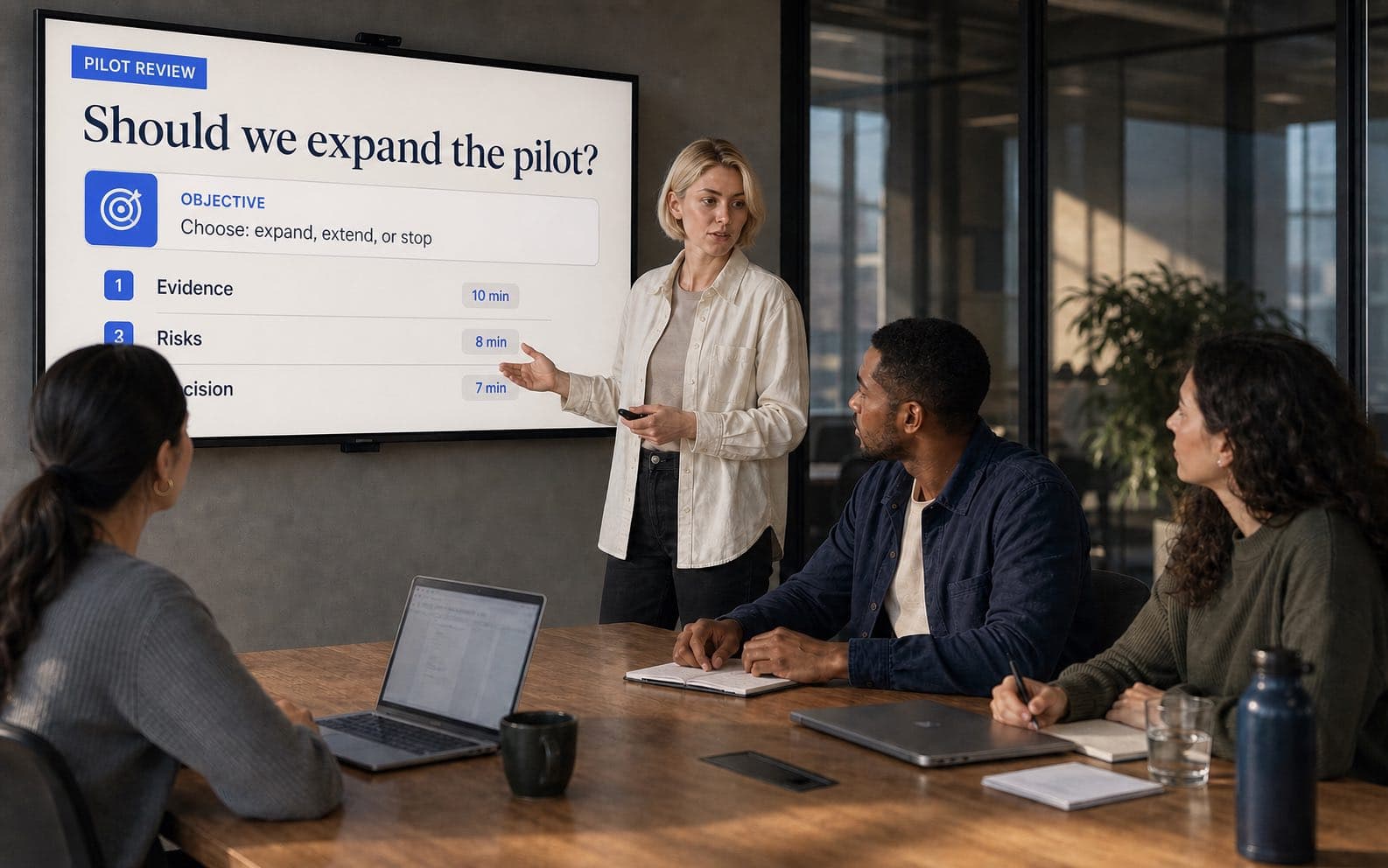
You forgot the meeting deck. Start with the objective and agenda
The meeting begins in minutes and the deck was never made. Recover the room with a clear objective, one decision and a short timed agenda instead of improvising slides.
 Meetings
Ownership is only the beginning of an action item
Assigning a task fixes ambiguity in the room, but it does not guarantee follow-through. An action item also needs a finish line, visible status and the context that made it matter.
 Product
Stop sending meeting recaps as attachments
A recap attachment starts becoming outdated the moment follow-up begins. Share one controlled meeting workspace so minutes, tasks, files and comments stay current together.
 Decisions
A decision log is only worth what you can find in it
Teams write decision records carefully and then never test the read. Retrieval, not recording, is where a log earns its keep — and people look things up by the constraint, not the title.